Wood-Veneer Feature Ceilings
Tongue-and-groove timber and wood-veneer slat & panel feature ceilings for Ghana homes, hotels and boardrooms — warm natural finishes installed with the moisture and acclimation discipline Ghana's 81–83% humidity demands. T&G vs veneer slat vs panel compared, on-survey pricing. Ceiling Experts Ghana, since 1980.
A wood ceiling brings a warmth no painted finish can — but timber is a living material, and in Ghana’s humidity it rewards discipline and punishes haste. Ceiling Experts Ghana has designed and installed tongue-and-groove and wood-veneer feature ceilings across Accra’s premium homes, hotels and boardrooms since 1980, treating the wood’s acclimation as the first job, not an afterthought.
Why a Wood-Veneer Feature Ceiling
Wood overhead changes a room — it warms a living space, softens a hard-surfaced lobby, and gives a boardroom a grade of finish that paint cannot reach. A timber or veneer ceiling reads as natural, tactile and expensive, and it carries grazing light beautifully so the grain comes alive after dark. The catch is that wood moves with moisture, so the look only lasts when the material is handled correctly for Ghana’s climate — which is exactly the part most installers skip.
Choosing the Right Timber Finish
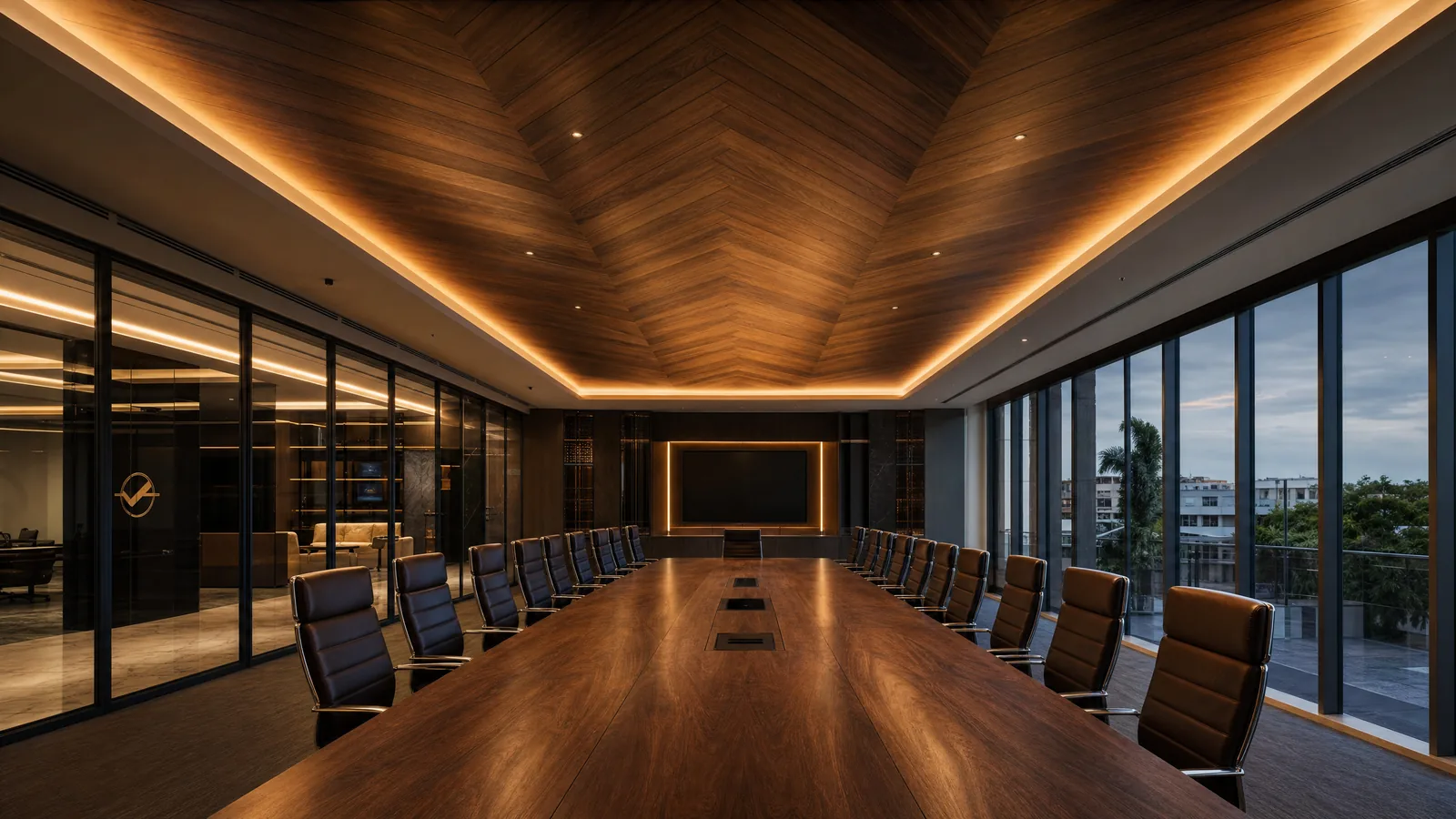
The finish is a room-and-area decision. Solid tongue-and-groove gives the deepest, most authentic board feel and suits rich residential and hospitality statements; veneered slat runs give rhythm and a contemporary linear look across a feature wall-to-ceiling sweep; wood-veneer panels cover large boardroom and lobby ceilings with a stable, lighter build and a faster install. We match the timber, the pattern and the finish to the room, the area, and how the ceiling will be lit.
Wood Ceiling Systems We Install
Solid Tongue-and-Groove Timber Ceilings
Real timber boards with a machined T&G profile, fixed to a level sub-frame — the most authentic, tactile wood ceiling, ideal for living rooms, dining rooms, master suites and hospitality statements. The boards are acclimatised to the room and fixed with a movement allowance so they stay tight through Ghana’s humid and dry seasons.
Wood-Veneer Slat Ceilings
Veneered slats run at a set spacing for a warm, linear, contemporary rhythm — often carried from a feature wall up across the ceiling, with grazing light between the slats to read the grain. A lighter, more stable build than solid boards, good over larger areas.
Wood-Veneer Panel Ceilings
Large wood-veneer panels on a concealed grid for boardrooms, lobbies and reception ceilings — the warmth of timber with the stability and coverage of a panel system, and a clean, fast install over big areas.
Integrated Grazing & Cove Lighting
Cove and grazing LED set out with the frame so light skims along the grain or between the slats — the detail that turns a wood ceiling from flat to dimensional after dark.
Solid T&G vs Veneer Slat vs Veneer Panel
| System | Best for | Look | Stability in humidity | Indicative cost (₵) |
|---|---|---|---|---|
| Solid tongue-and-groove | Living/dining rooms, master suites, hospitality | Deep, tactile real-timber boards | Acclimatise + movement allowance | on survey |
| Wood-veneer slat | Feature sweeps, contemporary rooms | Linear rhythm, grazed grain | Lighter, more stable | on survey |
| Wood-veneer panel | Boardrooms, lobbies, large areas | Warm timber over big spans | Most stable, panel-based | on survey |
(Timber and veneer feature ceilings are bespoke — the firm quote follows a free site measure; species, finish and area drive the cost.)
How We Design & Install a Wood Ceiling
- Survey, species & acclimation — room measured, timber/veneer confirmed, wood acclimatised to the room before fixing.
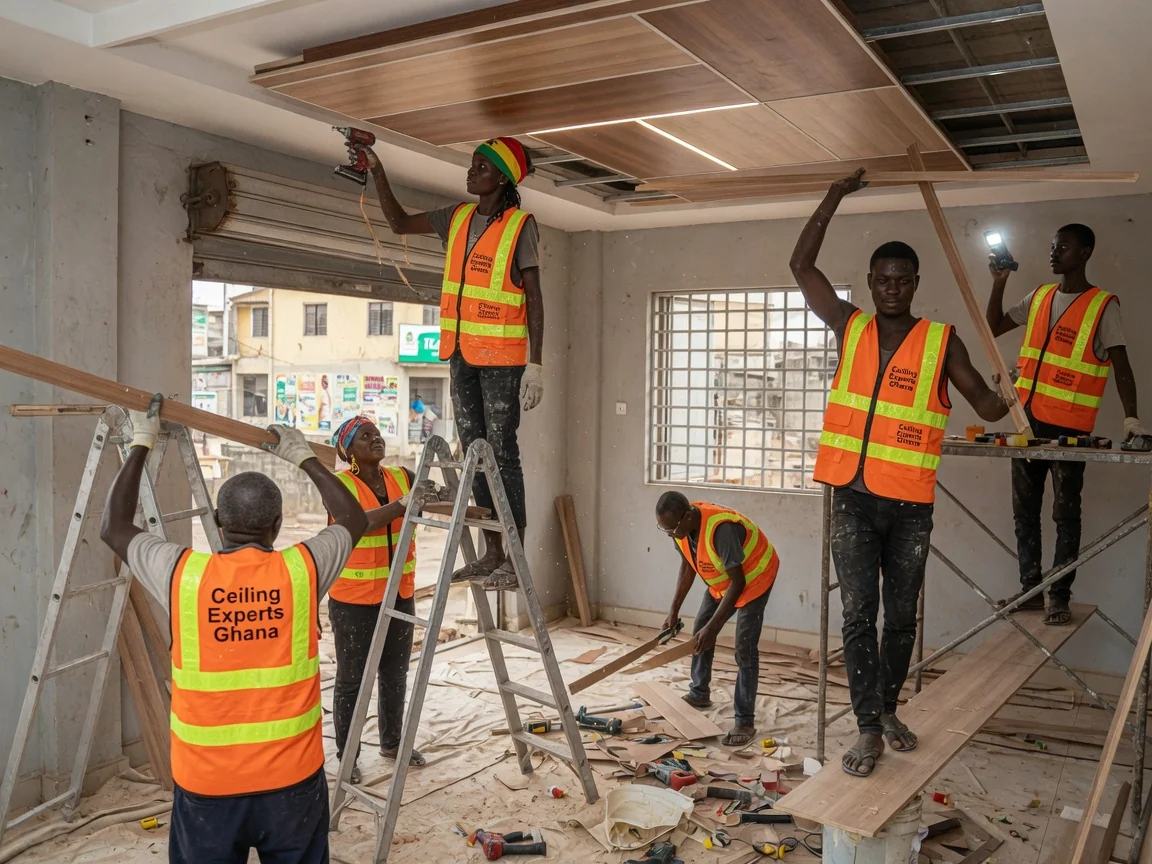
- Frame & setting-out — level sub-frame fixed; slat spacing or panel grid set out; lighting and void services positioned.
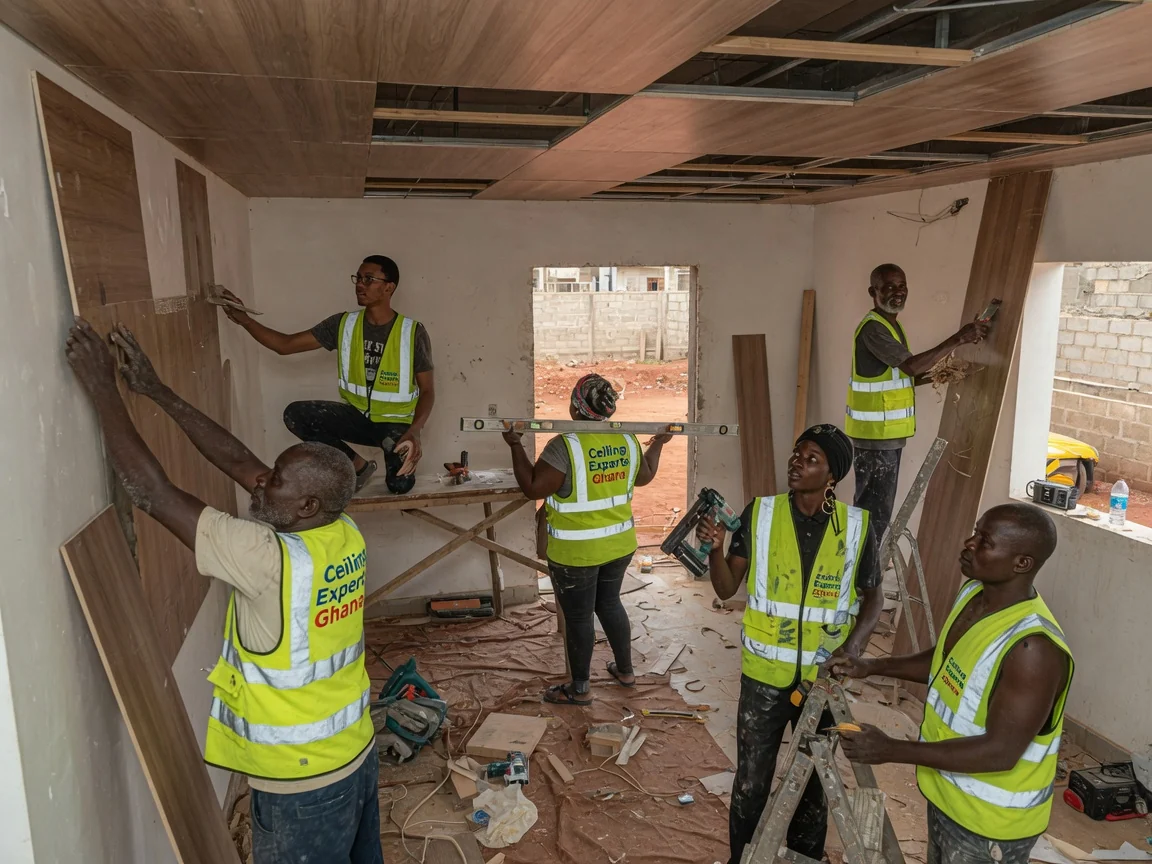
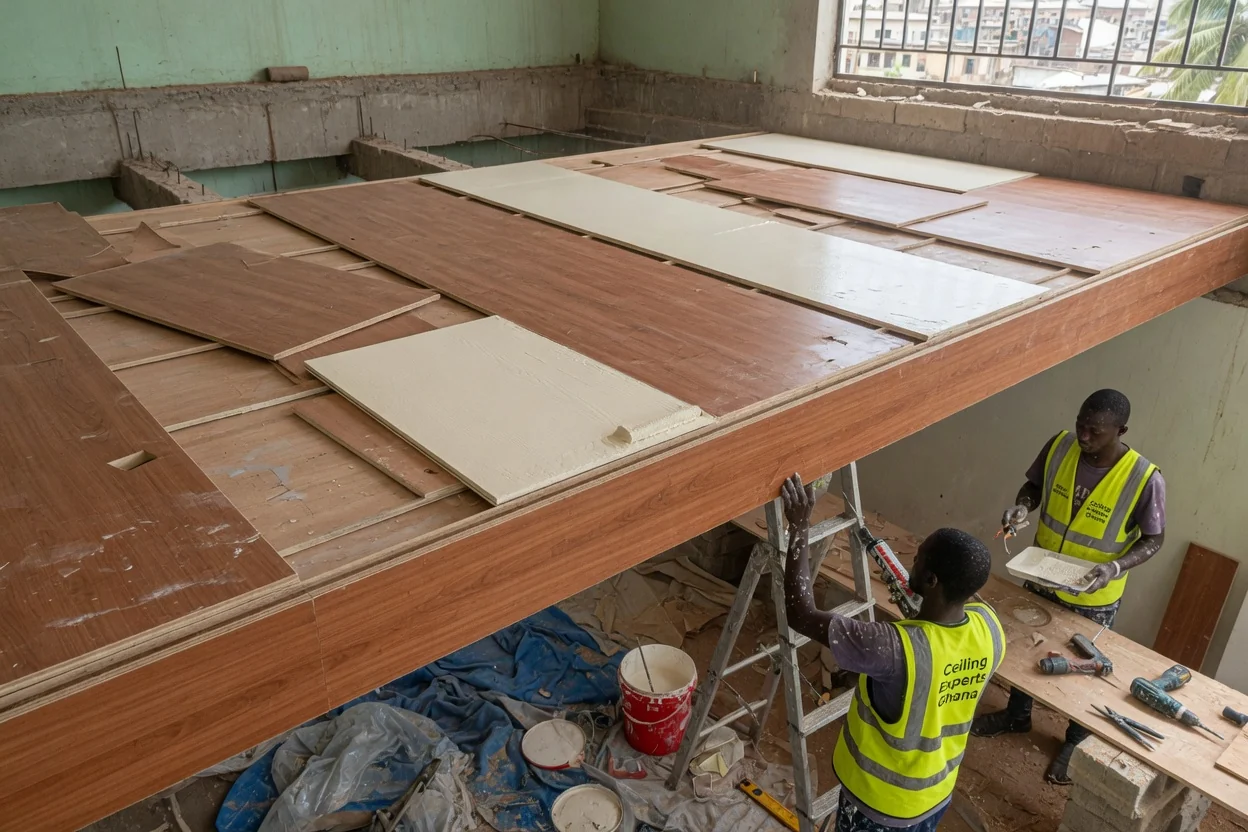
- Fix timber / veneer & detail — boards, slats or panels fixed with movement allowance; edges detailed; grazing/cove lighting built in.
- Finish, snag & handover — surface sealed/finished, install snagged against the design, room handed over clean.
Materials & Real Standards
- Moisture & acclimation discipline — Ghana sits at roughly 81–83% relative humidity, so timber that is fixed dry and rushed takes on moisture, swells and then shrinks, showing as cupping or open gaps. We acclimatise the wood to the room before fixing, fix with a movement allowance, and detail joints to absorb seasonal movement. This is workmanship, not a certificate — there is no product standard for solid-timber installation, and we do not claim one.
- Veneer & panel substrates — wood-veneer slats and panels are built on stable manufactured substrates; veneer, adhesive and any fire rating are per the manufacturer.
- Sub-frame & any board — where a gypsum/plasterboard element is used alongside the timber (e.g. a bordering soffit), that board is specified to ASTM C1396 / EN 520.
- Finish — timber is sealed or finished per the species and the room, to protect against moisture movement and keep the grain.
What Affects the Cost
- The timber species and grade, and whether it is solid T&G or veneer
- The pattern (board width, slat spacing, panel grid) and the design complexity
- The ceiling area (sqm), height, and access for working at height
- Integrated grazing/cove lighting and the number of light positions
- Surface preparation and any existing-ceiling removal
Timber and veneer feature ceilings are bespoke, so the price is on survey — no fixed rate is given before the room is seen and the species and design are confirmed.
Applications Across Ghana
- Living rooms, dining rooms and master suites in premium homes across East Legon, Airport Residential, Cantonments, Trasacco, Labone, and Ridge
- Boardrooms and corporate receptions in Airport City and central business districts
- Hotel lobbies, restaurants and lounges where warm timber sets the tone
- Apartments, villas and diaspora-managed new builds in Spintex, Adjiringanor, Dzorwulu, and Tema
- Homes and hospitality projects in Kumasi and Takoradi
Areas We Serve
Ceiling Experts Ghana designs and installs wood-veneer and tongue-and-groove feature ceilings across Greater Accra — East Legon, Airport Residential, Cantonments, Labone, Ridge, Trasacco, Spintex, Adjiringanor, Dzorwulu, and Tema — plus Kumasi and Takoradi.
Related Services
- Architectural Coffered Ceilings — coffered and architectural feature ceilings
- Bespoke Decorative Ceilings — domes, centre panels, decorative POP
- LED Luminous Ceilings — cove, grazing and integrated lighting
- Premium Residential Ceiling Systems — the full residential systems hub
Frequently Asked Questions
What is a wood-veneer feature ceiling, and where does it suit? A ceiling finished in real timber or wood veneer — tongue-and-groove boards, veneered slats, or wood panels — for a warm, natural, high-end feel. It suits living and dining rooms, master suites, hotel lobbies, restaurants and boardrooms.
Will a timber ceiling cup or gap in Ghana’s humidity? It can, if the wood is fixed dry and rushed. At roughly 81–83% humidity, un-acclimatised timber swells then shrinks, showing as cupping or gaps. We acclimatise the wood first, fix with a movement allowance, and detail the joints to absorb seasonal movement.
Solid tongue-and-groove or wood veneer — which should I choose? Solid T&G gives the deepest, most authentic board feel for rich residential and hospitality statements; wood-veneer slats and panels give the same warmth with a lighter, more stable build and faster install over large boardrooms and lobbies.
How much does a wood-veneer feature ceiling cost? It is bespoke, so the price is on survey — species, finish, area, pattern and lighting drive the cost. We give a firm quote after a free site measure rather than a fixed rate.